

Most happy customers would gladly leave you a review. The problem is that nobody asked them.
The fastest way to get more Google reviews is to ask every customer, right after a good experience, with a direct link that takes them straight to your review form. Most people who are asked will follow through. Most people who aren’t asked never think about it.
This is for small business owners who know reviews matter but feel awkward asking, or who have tried and only gotten a trickle. It’s also for anyone who has been tempted by shortcuts like discounts for reviews or only asking the customers you know are happy. Some of those shortcuts now break Google’s rules and federal law.
We’ll cover why reviews matter so much, how to ask without feeling pushy, what’s off-limits, and how to handle the reviews you’d rather not get.
Quick Take
- Almost every customer reads reviews before choosing a local business.
- Recent reviews count more than old ones. Most people only trust reviews from the last few months.
- The single biggest factor in getting reviews is asking. Most people who are asked will leave one.
- Offering a reward for a positive review, or only asking happy customers, can get your reviews removed and break federal rules.
- Responding to every review, good and bad, makes customers more likely to choose you.
At Forward Digital Marketing, we work with small businesses across Southeast Georgia and beyond who want their marketing to build real trust — not just create activity. Reviews are the closest thing to word of mouth the internet has, and a steady stream of them often does more for a local business than any ad.
Why Do Google Reviews Matter So Much for a Small Business?
Google reviews are often the first thing a potential customer sees about your business, before your website, your social media, or your sign out front. They tell people whether you’re trustworthy, active, and worth a call. They also help Google decide which local businesses to show when someone searches nearby.
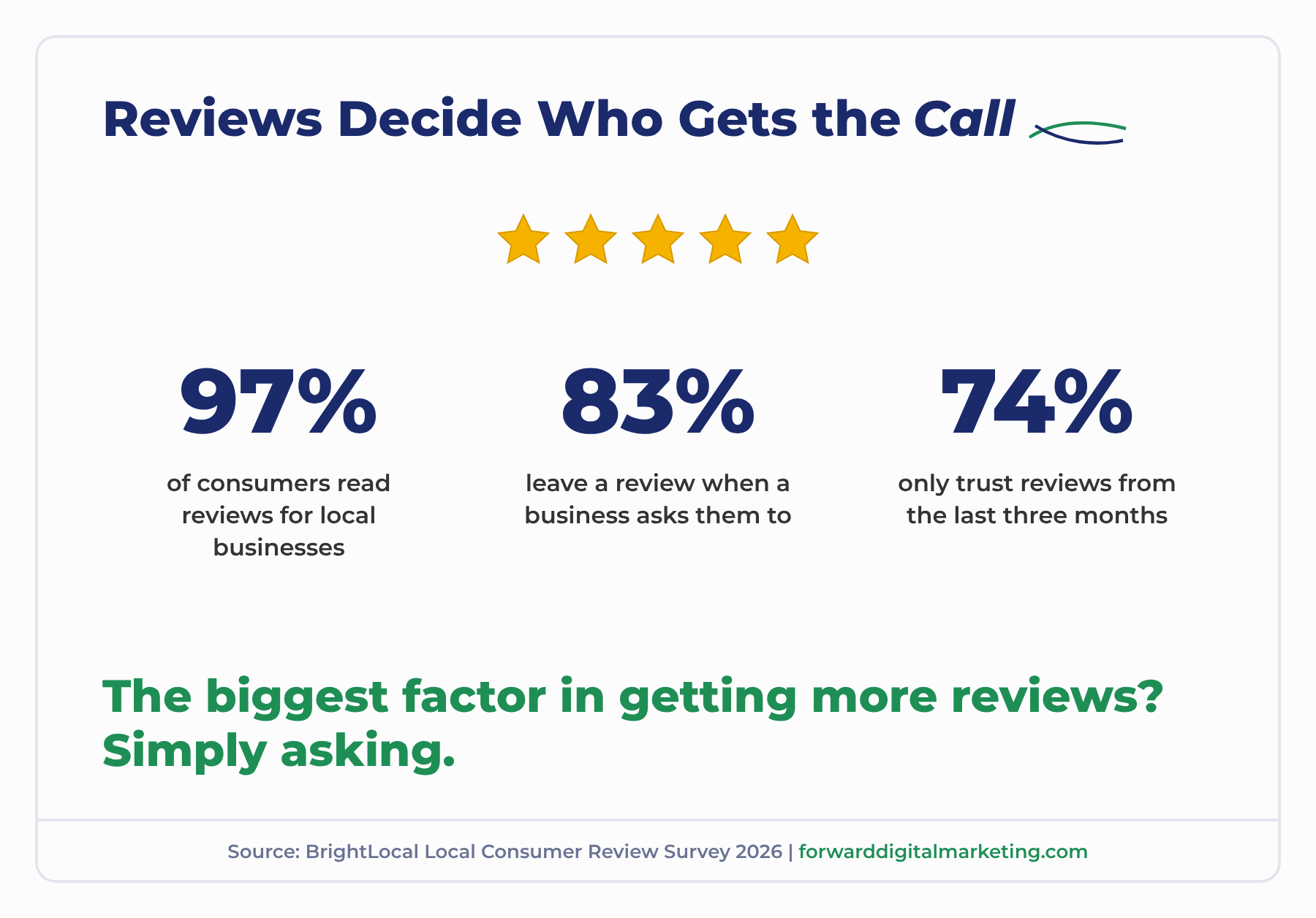
The research is hard to argue with. According to BrightLocal’s Local Consumer Review Survey, 97% of consumers read reviews for local businesses, and 68% will only use a business with a rating of four stars or higher.
Reviews feed AI search too. When someone asks an AI tool for the best plumber or florist in town, it pulls from what customers have said publicly. A business with plenty of recent, detailed reviews gives those tools something to work with. We cover that connection more in how to show up in AI search without paying.
How Do I Ask Customers for Google Reviews?
Ask in person or by text right after a good experience, and send a direct link to your review form. Keep the request short, personal, and easy. The less work it takes, the more reviews you’ll get.
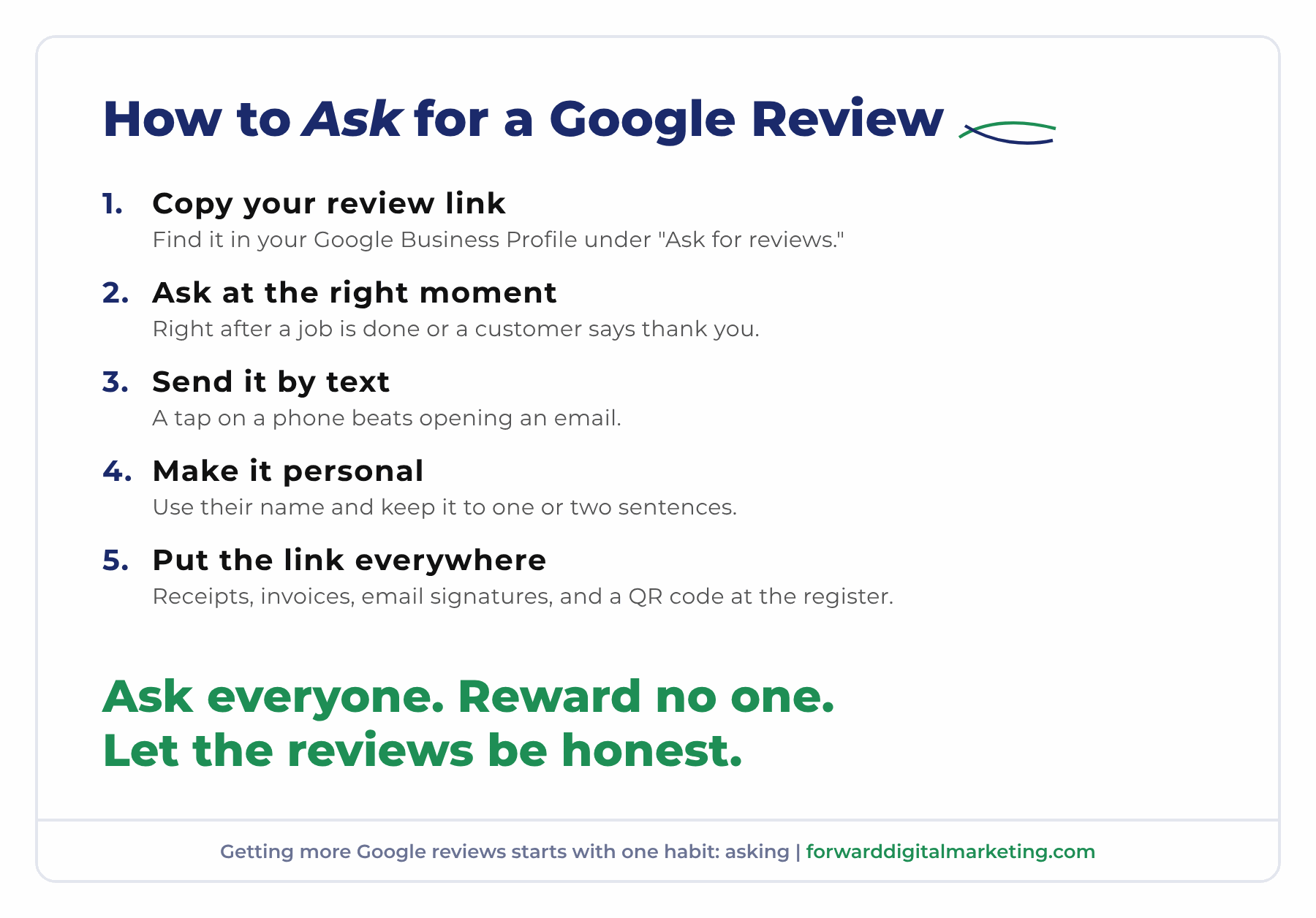
Asking really is the whole game. In the same BrightLocal survey, 83% of people who were asked to leave a review went on to do it. Here’s how to make asking part of your routine:
- Get your review link: In your Google Business Profile, choose the option to ask for reviews and copy the short link Google gives you.
- Ask at the right moment: right after a job is finished, a problem is solved, or a customer says thank you.
- Send it by text: most people will tap a link on their phone faster than they’ll open an email.
- Make it personal: “Thanks for trusting us with your roof, Ms. Carter. If you have a minute, a quick Google review helps us more than you know.”
- Put the link everywhere it fits: receipts, invoices, email signatures, and a QR code at the register.
What Are Google’s Rules for Getting Reviews?
You can ask any customer for an honest review. You can’t pay for reviews, offer a reward in exchange for one, or ask only the customers you know are happy. Google removes reviews that break these rules, and repeat problems can put your whole Business Profile at risk.
Two common practices cause most of the trouble:
- Rewards for reviews: discounts, free products, or entries into a drawing in exchange for a review. Even if you don’t ask for five stars, Google treats this as a violation.
- Review gating: sending a survey first and only passing satisfied customers along to Google. Google prohibits this, whether you do it by hand or a software tool does it for you.
This isn’t only a Google issue anymore. The Federal Trade Commission’s Consumer Review Rule bans fake reviews, rewards tied to positive reviews, and suppressing negative ones, with civil penalties that can reach tens of thousands of dollars per violation. The FTC has already sent warning letters to businesses it believes are breaking the rule. The safe approach is simple: ask everyone, reward no one, and let the reviews be honest.
What This Means for Your Business
For a local small business, reviews work best as a habit, not a campaign. Ten reviews spread across the year look more trustworthy than ten that showed up in one week and then stopped. Recency matters too: BrightLocal found 74% of consumers only pay attention to reviews from the last three months.
In a small town, your reputation already travels by word of mouth. Reviews just put that word of mouth where new customers can see it. The businesses that build a steady stream of reviews treat asking as part of finishing the job, as routine as handing over the invoice.
Responding counts as much as collecting. BrightLocal found 89% of consumers expect businesses to respond to reviews. Thank people by name for good reviews. For bad ones, stay calm, keep it short, and offer to make it right offline. Future customers are reading your reply as much as the review itself.
Frequently Asked Questions
Can I ask my customers for Google reviews?
Yes. Google allows businesses to ask customers for reviews. Ask every customer, not just the ones you think are happy, and don’t tell them what rating to leave.
Can I offer a discount or freebie for a Google review?
No. Google doesn’t allow rewards in exchange for reviews, even if you don’t ask for a positive one. Reviews tied to incentives can be removed, and rewards tied to positive reviews also violate the FTC’s Consumer Review Rule.
How many Google reviews does my business need?
There’s no magic number, but you want enough recent reviews that a new customer sees steady activity. Consistency matters more than volume. A few new reviews every month beats a big burst followed by silence.
Why did my Google review disappear?
Google’s filters remove reviews they flag as suspicious, such as several reviews from the same location, reviews posted right after a link was shared widely, or reviews that break content rules. Asking customers steadily over time, rather than all at once, helps avoid this.
Can I delete a bad Google review?
No, you can’t delete a review yourself. If a review breaks Google’s policies, such as spam, a fake review, or offensive content, you can report it from your Business Profile. Otherwise, the best move is a calm, professional response.
Should I respond to negative reviews?
Yes. Respond politely, acknowledge the concern, and offer to fix it offline. Don’t argue in public. A thoughtful reply shows future customers how you treat people when something goes wrong.
What to Do Next
More reviews don’t come from luck or from a clever trick. They come from asking every customer, every time, and making it easy for them to say yes.
Grab your review link
Copy your Google review link today and save it in your phone so you can text it to customers in seconds.
Build it into your routine
Pick the exact moment you’ll ask, such as at checkout or when a job wraps up, and add your link to your Google Business Profile strategy.
Get a second set of eyes
Want a review process that fits your business and stays within the rules? We’ll help you set it up.