

Category: Uncategorized

  • What Are Website Hosting Basics for Small Business (It’s Super Important To Know)

    What Are Website Hosting Basics for Small Business (It’s Super Important To Know)

    4–6 minutes

    “Web hosting is an essential part of any online business. It’s the foundation upon which your website is built.”

    Neil Patel, digital marketing expert

    Many small business owners know they “have a website,” but fewer know where that website actually lives or who controls it. That’s especially common in rural communities, where websites were often set up years ago by a freelancer, a friend, or a marketing company that’s no longer involved.

    Website hosting used to be simple. You picked a provider, paid a small fee, and didn’t think about it again. Today, hosting affects website speed, security, reliability, and even whether you fully own your site. As websites have become more complex, the risks of not understanding hosting have grown quietly in the background.

    We regularly talk with business owners who don’t know who their hosting provider is, who has the login, or what happens if something goes wrong. That uncertainty can create real problems when a site needs updates, repairs, or a rebuild.

    Quick Take

    • Website hosting is where your site lives and runs
    • Hosting affects speed, security, and uptime
    • Many businesses don’t control their own hosting
    • Not knowing your host creates avoidable risk
    • Hosting should support your business, not complicate it

    Forward Digital Marketing has been hosting sites for over 26 years! We help small business feel confident and secure about their websites.

    What Is Website Hosting and Why Does It Matter?

    Website hosting is the service that stores your website’s files and delivers them to visitors when they type in your web address. Hosting is not the same as your domain name. Without hosting, your website cannot be accessed online. The quality and setup of that hosting directly affect how fast your site loads, how secure it is, and how often it’s available. For small businesses, hosting is not just a technical detail—it’s part of basic business infrastructure.

    Hosting Determines Whether Your Website Is Reliable

    Your hosting provider controls the environment your website runs in. If that environment is unstable or outdated, your site will reflect that.

    Common reliability issues tied to poor hosting include:

    • Frequent downtime or “site not available” errors
    • Slow page load times, especially during busy hours
    • Limited support when something breaks

    For customers, these problems reduce trust quickly. For business owners, they often go unnoticed until a complaint or lost lead appears.

    Not Knowing Your Hosting Puts You at Risk

    Many small businesses don’t know who manages their hosting, how access is handled, or what happens if changes are needed. Sometimes it’s owned by a former vendor or bundled into a service they no longer use.

    This can lead to:

    • No clear documentation of who manages hosting
    • No defined process for updates, fixes, or emergencies
    • Unclear ownership of website files and data
    • Difficulty transitioning if vendors change

    Hosting Has Changed as Websites Have Changed

    Modern websites are expected to do more than display basic information. They handle forms, updates, integrations, and security requirements that didn’t exist years ago.

    Older hosting setups often lack:

    • Regular security updates
    • Automatic backups
    • Compatibility with modern website software
    • Support for accessibility and performance standards

    What worked when a site was first launched may no longer be sufficient today. Modern hosting is often shared, secured, and professionally managed. The goal is not hands-on access, but clear accountability, documentation, and protection across all sites on the server.

    What This Means for Businesses

    Hosting should be something you understand at a basic level, even if you never manage it yourself. Knowing where your site is hosted, who controls it, and what protections are in place reduces risk and frustration.

    When hosting is ignored:

    • Small issues become big disruptions
    • Website improvements take longer than necessary
    • Businesses lose control over their own digital assets

    Clear hosting ownership and structure make everything else—updates, redesigns, security—simpler and more predictable.

    Frequently Asked Questions

    Do I need to manage my own website hosting?
    No. Many businesses choose to have hosting managed for them. What matters is that you know who manages it and that you retain access and ownership.

    Is hosting the same as my domain name?
    No. Your domain is your website’s address. Hosting is where the website itself lives. They are related but separate services.

    Can poor hosting affect my search visibility?
    Yes. Slow load times and frequent downtime can negatively affect user experience and search performance over time.

    What happens if my hosting provider shuts down or stops responding?
    If hosting is professionally managed, there should be a documented process for backups, recovery, and transition. The risk arises when there is no clarity on ownership, backups, or who is responsible for action if something changes.

    How often should hosting be reviewed?
    At least every couple of years, or whenever you plan a website update, redesign, or major change in services.

    Do I need direct access to my hosting server?
    No. Most professionally managed hosting environments restrict direct access to protect performance and security for all clients. What matters is that you understand who manages the hosting, how requests are handled, and that your website can be transitioned if needed.

    At Forward Digital Marketing, we’ve hosted small business websites for over 26 years, and one pattern shows up consistently: problems usually start when no one knows who’s responsible for the foundation. Hosting doesn’t need to be complicated, but it does need to be intentional. Having clear systems and ownership in place gives businesses the stability they need to grow without unnecessary surprises.

    Want to know where your website is hosted and how it is managed?

    Many business owners don’t have clear answers until a problem forces the issue. A simple hosting review can clarify management, ownership, backups, and next steps—without requiring hands-on server access.

    Get Digital Marketing Headlines Found for YOU!

    We don’t spam! Read more in our privacy policy

  • Ways to Boost your Email List

    Ways to Boost your Email List

    So let’s start off with the bad news first to get it out of the way…

    “Email marketing databases naturally degrade by about 22.5% every year.” – Hubspot

    How can that be? The biggest reason is because people switch jobs, they retire, finally get a new email address because they are still using AOL, things like that.

    Thankfully, GOOD NEWS is here to stay…

    “The average expected ROI is $42 for every $1 you spend on email marketing.” – Data & Marketing Association

    Considering this statement, that is why the ‘quality over quantity’ phrase is so true! It does not matter if you have 10 or 200 people signed up to receive your email, what matters is their engagement. So although we are talking about how to grow in email marketing, we want to stress the importance of keeping your subscribers active as well.

    In-Person

    This could be word of mouth, a sign up sheet in a local business, attending craft shows or festivals in town, business cards, local events, the possibilities are endless! Human interaction is still very effective – it’s harder for people to turn you down when you are standing in front of them. Who knows, they might actually like your company after they give it a shot!

    Website

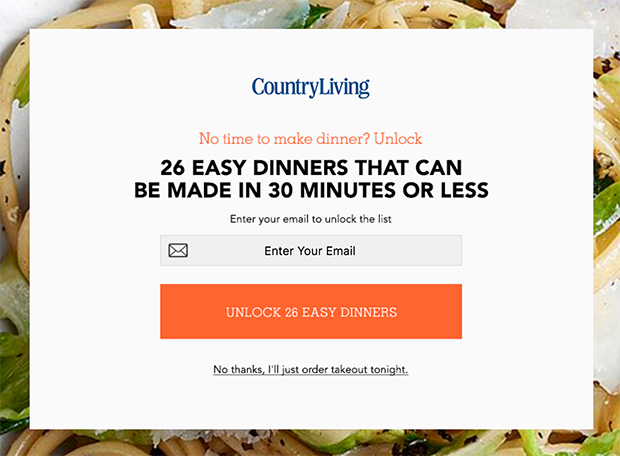
    Email features have become more and more popular. However, you don’t want to hound them for meaningless information. Keep it simple – name and email. You can find out details later after building a relationship with them! You can also get as creative as you want with it. Here is a simple example from Country Living:
    New Content

    Whether it is a free online tool, resource, brand structure, contest or promotion, you can use a landing page to gather email addresses. You want them to see it as a ‘bonus’ to get something in return because let’s face it, nobody does anything ‘just because’ if they aren’t benefiting from it. While getting your new content out there to the Internet, you could also ask them for feedback from a live chat tool. This could be through social media or your website for people that have stayed on your page for a certain amount of time.

    Social Sharing Buttons

    For people to want to share your content, it has got to be top notch. When you are able to fine tune it, you’ll have more confidence to encourage your subscribers to share on social media or forward your email to colleagues which makes it important to still include a Call to Action to subscribe in your emails (even though the people you originally emailed it to are already subscribed).

    We hope these tips can help you get recognized in your community. Keep in mind that:

    You’re only as successful as your least engaged subscriber.

    Thanks for reading and don’t forget to keep up with us on our social media!

    Feel free to look back at our previous posts for more content!

    Always Looking Forward,

    Shelby

  • The 2000’s

    The 2000’s

    Infographic: A Decade in Tech | Statista You will find more infographics at Statista