
Most business owners write their website for themselves, but visitors are looking for answers to their own questions. That gap between what you wrote and what they needed is usually where the message gets lost (and they bounce).
This is for small business owners, local service providers, and regional organizations who have a website, but aren’t sure it’s actually working. If you’ve ever looked at your homepage content and thought ‘this seems fine, but people aren’t calling,’ you’re not alone.
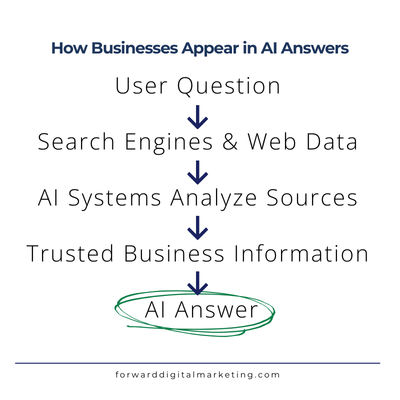
Visitors land on your homepage with very little patience. They’ve already seen several other options in the same search. They’re scanning, not reading. On top of that, AI-powered search tools now read and summarize your website when someone asks a relevant question, and if your site is vague or hard to follow, it doesn’t get recommended.
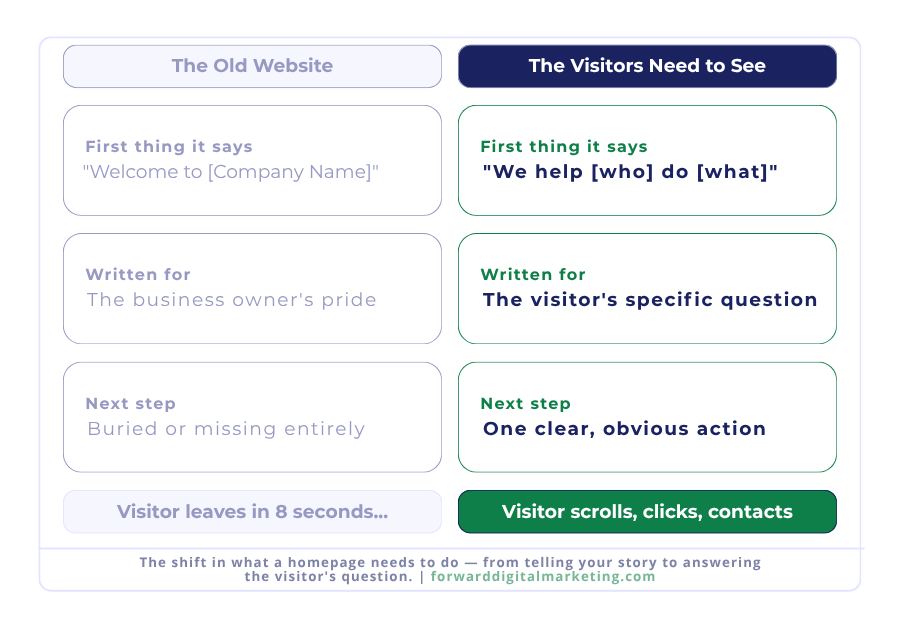
The old approach — put your company name at the top, add a nice photo, and list your services — doesn’t work as well anymore. Visitors need to know within a few seconds that they’re in the right place, that you understand their situation, and that there’s a clear next step. Most homepages miss all three.
Quick Take
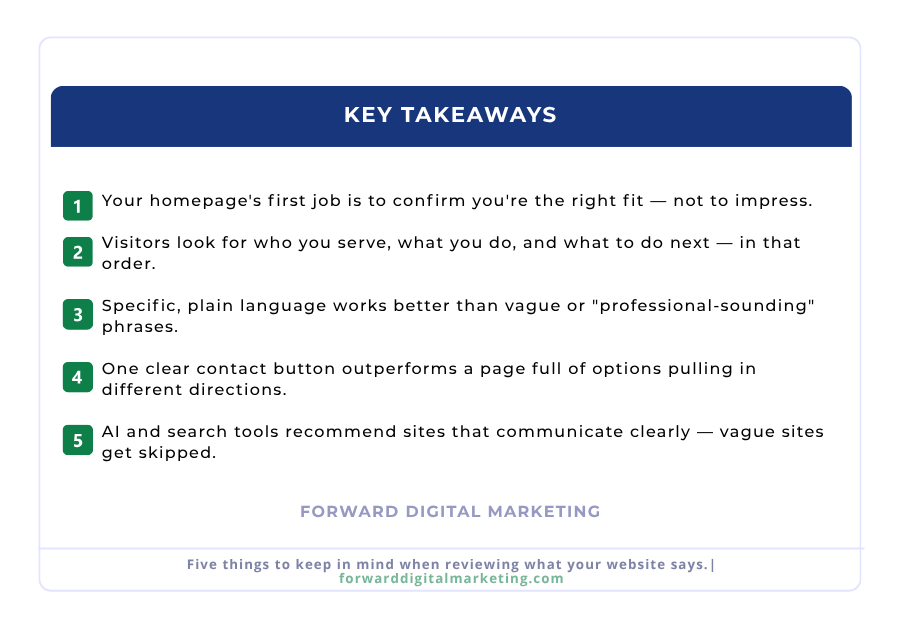
- Most websites are written from the business owner’s perspective, not the visitor’s.
- Visitors spend seconds deciding whether to stay — what your site says first has to answer “is this for me?” immediately.
- A homepage that works has one clear message, one audience, and one next step.
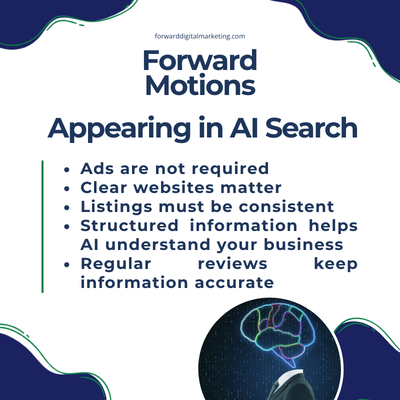
- Search engines and AI tools now read your website and summarize it — unclear language gets skipped entirely.
- Fixing what your website says doesn’t require a redesign. It requires being clear about what you do and who you do it for.
At Forward Digital Marketing, we work with small businesses and regional organizations that want their marketing to function as a system. Your homepage is almost always where that work starts, because it determines whether everything else you’re doing to drive traffic actually pays off.
- What Should Your Homepage Actually Say?
- Why Most Small Business Homepage Content Misses the Mark
- Clear and Specific Beats Clever, Every Time
- Your Contact Button Needs to Be Obvious and Singular
- What This Means for Your Business
- Frequently Asked Questions
- What to Do Next
- Do it yourself
- Do a quick check
- Get a second set of eyes
What Should Your Homepage Actually Say?
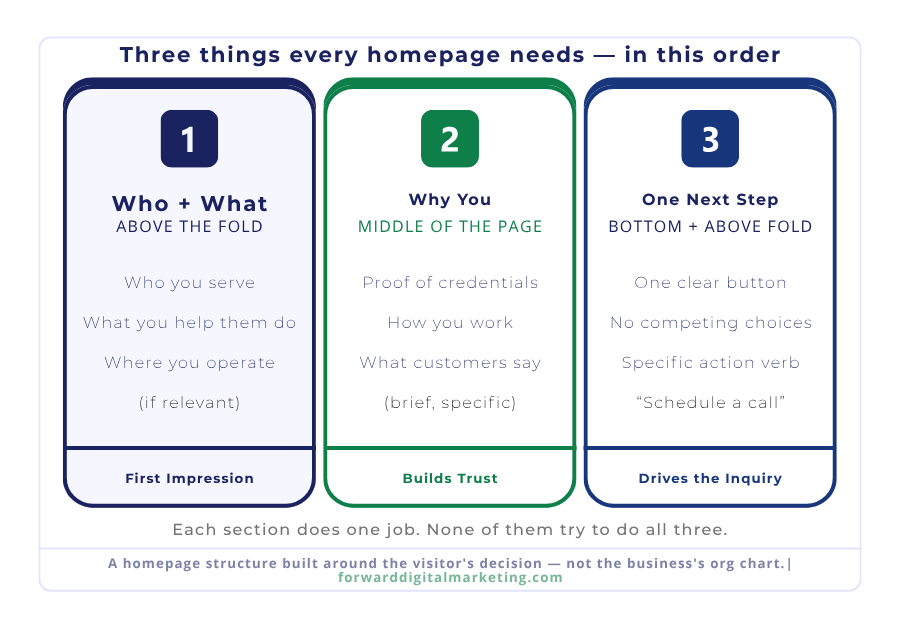
A homepage that gets people to call has three things in the right order. The goal isn’t to explain everything about your business — it’s to help the right visitor confirm they’re in the right place and feel comfortable taking action.
- Who you help and what you help them do. This goes first, above everything else.
- A brief reason why you’re the right choice. Proof, experience, or a simple description of how you work.
- One specific next step. One button, one action, one clear ask.
If a sentence on your page doesn’t support one of those three things, it’s probably getting in the way.
Why Most Small Business Homepage Content Misses the Mark
Business owners naturally write about themselves. “We’ve been serving the community since 1998.” “Our team is passionate about quality.” These feel meaningful to write, but to someone visiting your site for the first time, they don’t answer the only question that matters: can you help me with my specific problem?
When a potential customer finds your website, they arrive with a problem or a question. If the first thing they see is your company name or a tagline about your values, they have to do extra work to figure out whether you’re relevant. Most won’t bother. Here’s what to think about instead:
- What does your customer already know about their problem? Start from where they are, not where you are.
- What words do they use to describe what they need? Use those words, not your industry’s words.
- What outcome are they looking for? Name the result, not just the service.
Starting there — instead of starting with “about us” — is what creates the feeling of “this is exactly what I was looking for.”
Clear and Specific Beats Clever, Every Time
There’s a common belief that what your website says should sound polished or brand-forward. In practice, that usually produces headlines that sound impressive and say nothing — “Transforming the way you think about your business” or “Solutions built for tomorrow.”
Clear doesn’t mean boring. It means your visitor doesn’t have to guess. Compare these two:
- “We handle payroll and HR paperwork for small construction companies in Georgia” — visitor knows immediately if this is for them.
- “Streamlined people operations for growing teams” — visitor has to work to figure out if it applies to them.
Specific language also does double duty for your visibility online:
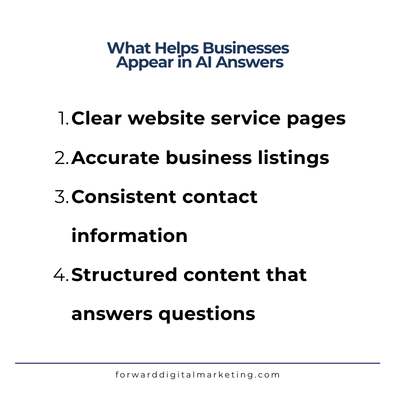
- Plain, specific language indexes better in search and gets picked up more reliably by AI tools.
- Vague words like “innovative,” “dedicated,” and “full-service” add length without adding information.
- Describing your actual service area, the type of customer you serve, and the outcome you provide is both better writing and better SEO.
Your Contact Button Needs to Be Obvious and Singular
One of the most common problems we see isn’t a missing contact button — it’s having too many of them. “Contact us. Sign up for our newsletter. Download our guide. Follow us on Instagram.” When visitors are pointed in every direction at once, most of them go nowhere.
Your homepage should have one primary action you want visitors to take. The right one depends on how you actually get new customers:
- If your business runs on consultations or estimates, the action is “Schedule a call” or “Request a quote.”
- If you have a physical location, it’s “Get directions” or “Book an appointment.”
- If you sell something directly, it’s a specific product or service link — not a general “shop” page.
- If you’re a municipal or community organization, it’s “Find your service” or “Contact your department.”
The button text matters too. “Get Started” is vague. “Schedule a Free Estimate” tells the visitor exactly what happens next — and that removes a layer of hesitation from the decision.
What This Means for Your Business
If your website is getting visitors but not producing calls or inquiries, it’s usually not a design problem. It’s a clarity problem. Redesigns are expensive and take time — but updating what your site says costs far less and can make a more immediate difference.
Start with a simple self-check. Read your own homepage as if you’ve never heard of your business and ask:
- Does the first sentence tell you who this is for?
- Does it tell you what problem gets solved?
- Is there one clear thing to do next?
If any of those answers are no, that’s where to start. There’s also a growing risk for businesses that rely on local search. When someone asks an AI tool or voice assistant “who does [service] in [city],” those tools read and summarize business websites to form their answers. A website with vague or outdated language doesn’t summarize well — and in many cases, it doesn’t get recommended at all.
Frequently Asked Questions
How much text does my homepage actually need?
Enough to answer three questions — who this is for, what you do, and what to do next — and not much more. For most small service businesses, that’s somewhere between 200 and 400 words of visible text. Structure matters more than length. A short, organized page almost always outperforms a long, cluttered one.
Should I list all my services on my homepage?
Not in detail. Your homepage should name your main service categories and link to separate pages where visitors can read more. Listing every service with descriptions creates clutter and pulls attention away from your main contact button. Use your homepage to point people in the right direction — not to sell everything at once.
Do I need to include my city or service area on my homepage?
Yes, and it matters more than most business owners realize. A line like “Serving Wayne, Brantley, and Pierce counties” or “Based in Jesup, GA” helps both visitors and search engines confirm you’re relevant to local searches. It’s also one of the signals AI tools use when recommending local businesses.
Do I need to include my city or service area on my homepage?
Yes, and it matters more than most business owners realize. A line like “Serving Wayne, Brantley, and Pierce counties” or “Based in Jesup, GA” helps both visitors and search engines confirm you’re relevant to local searches. It’s also one of the signals AI tools use when recommending local businesses.
How often should I update what my website says?
Review it at least once a year, and any time your main service, your target customer, or your service area changes. Also, take a look if you notice inquiries slowing down or if the calls you’re getting don’t match the work you actually want to do. Outdated information is often the cause of both problems.
What’s the most common mistake small businesses make on their homepage?
Using the business name as the headline. Visitors already saw your name in search results — they don’t need it again as the biggest text on the page. That space should tell them what you do and who you do it for. Save the name for your logo.
What if my business serves more than one type of customer?
You can serve multiple audiences, but your main message should speak to your most common customer. If you genuinely have two very different groups, a short “who we work with” section can point each one to the right place. Trying to write one opening line that addresses everyone usually ends up reaching no one clearly.
What to Do Next
Your homepage is usually the right place to start because it determines whether everything else you’re doing to drive traffic actually pays off. If people are finding you but not calling, the answer is almost always in what your site says — not in a full redesign. Here are three practical places to begin depending on where you are right now.
Do it yourself
Read your homepage out loud as if you’ve never heard of your business. If the first sentence doesn’t say who you help and what you do, rewrite it. One clear sentence does more work than any tagline.
Do a quick check
Ask three questions: Does your headline name a specific audience? Is there one obvious contact button? Does the page load and read well on a phone? Those three will show you exactly where the gaps are.
Get a second set of eyes
Ask someone outside your business what they think you do after reading your homepage. The gap between their answer and your actual service is usually exactly where the work needs to happen.